Showing posts with label Chess Books. Show all posts

Monday, October 15, 2007

Rook's Rudimentary Resources - Yasser Seirawan "Winning Chess Series"

This is not necessarily a recommendation (or even a review), I'm listing it simply as a resource to be explored.

This series was first brought to my attention by Greg over at Greg's Chess Progress. Greg has used several books in the series to improve his game, and having moved on to more advanced things and through a very magnanimous gesture - Thanks, Greg! - sent me several books in the series he no longer had a use for.

From what I can gather about the series, they were first published by Microsoft Press as four volume set and then later expanded to six volumes. Eventually the series was picked up by Everyman Chess and they currently publish the entire series. Everyman says the Winning Chess Series is "probably the best-selling series of chess books ever published." It certainly seems to be a comprehensive series, starting from the very basics with volume one Play Winning Chess and from there covering tactics, strategies, openings, endgames, and combinations.

So far, I have only been able to read a single chapter, chapter one entitled "Early Days" in the Winning Chess Openings book. It was great fun to read! I actually laughed out loud while reading it because, in the example games he gives, I saw myself doing the same things he did (and millions of other beginners have done) when they first learn how to play the opening. Not only were the games amusing they were very educational - thanks to the insightful comments by Mr. Seirawan. If the rest of the material is up to this quality I expect this series to be very good. As I work through the books I hope to give full reviews of each. That's going to takes some time though ;-) For what it's worth, I noticed the customer review’s at Amazon were uniformly high – 4 to 5 stars – for all seven volumes!

Here is a detailed list of the series (including the back cover summaries):

Winning Chess Series by Yasser Seirawan

  1. Play Winning Chess - An introduction to chess and some basic strategies. "In this first of a four part series, Seirawan talks to the chess novice. He explains the game's development and basics of play, sharing stories of some of the wild and wonderful characters from chess history and Seirawan's own experiences. The language is simple and nontechnical enough for the greenest newcomer, who will hardly seem green at all after absorbing the lessons of this terrific introduction to chess."
    Microsoft Press 1990, 1998
  2. Winning Chess Tactics - An introduction to tactics with puzzles. "This is the second in Seirawan's four volumes, taking the reader from the very basics of chess through appreciation of advanced play. He does a remarkable job of discussing tactics that usually appear only in books for advanced players and communicating them to anyone with a grasp of playing fundamentals. The first part of the book deals with basic tactics and how they can be used individually and in combination. In the second part, Seirawan introduces some of the great chess tacticians and their games, further illustrating tactics as they work out in real-life play. "
    Microsoft Press 1992, 1998
  3. Winning Chess Strategies - A book on how to use small advantages and use strategies to make them. "This is the third of Seirawan's four-volume series, which takes the reader from chess greenhorn to a player advanced enough to understand grandmaster play. Here, Seirawan shows how to set long-range goals for a game and systematically gain a superior position. His deft explanations give anyone with basic chess knowledge (covered in his previous books) the insights to leap levels in play. As usual, he tackles the subject with an infectious enthusiasm, communicating the sporting thrill as each piece of a meticulous plan comes together. Throughout the book, engrossing chess puzzles help teach strategic points."
    Microsoft Press 1994, 1998
  4. Winning Chess Brilliancies - Notable games in chess that are analyzed by the author. "Seirawan does more than present 12 of the most brilliant grandmaster games of the past 25 years. His lively move-by-move analysis delves into the minds of many of chess's greatest players, explaining the reasoning (or errors) behind each. Readers with a grasp of chess basics, tactics, and strategies (covered in the first three books of Seirawan's four-book series) will come away with an appreciation of the subtleties of grandmaster play and the inspiration to stretch their skills and understanding to higher levels. Have another chess player nearby when you read it--you'll want to play afterwards."
    Microsoft Press 1995, 1998
  5. Winning Chess Openings - Gives a brief description on hundreds of the most popular openings, as well as opening strategies. "The two greatest challenges for beginning chess players are not only to survive the openings phase, but also to choose appropriate attack and defense formations in the process. Winning Chess Openings shows you how to do both. In Yasser Seirawan's entertaining, easy-to-follow style, you're shown formations that can be used with other White or Black pieces. Winning Chess Openings explains how to: build a safe house for a king; estimate losses of ten moves or fewer; utilize the elements: time, force, space and pawn structure; plan strategy based on time-tested opening principles; employ a defense for Black against any White opening; apply an opening for White used by World Champions."
    Microsoft Press 1998
  6. Winning Chess Endings - Introduction to the endgame. "Good books about endgames for beginners are few and far between. Winning Chess Endings is a great one - a gripping introduction to what you need to know to win chess endings, taught by American Grandmaster Yasser Seirawan. His entertaining, easy-to-understand style, incisive stories and insiders advice will help you develop a solid grasp of proven principles that you can apply with confidence whenever a game goes the distance. You'll learn to prevail time and again in endgames with common and uncommon combinations and pieces. Winning Chess Endings explains how to: relentlessly find checkmates, from easy to hard, in all basic endgame patterns; master the intricacies of King and Pawn Endings; win consistently in the most common endgame - the Rook ending; master the pros and cons of Bishop vs. Knight Endgames; seize the advantage in Rook Pawn and Queen Pawn endings; play like a grandmaster in solitaire endings."
    Microsoft Press 1999
  7. Winning Chess Combinations - Teaches players how to recognize the main combination patterns; somewhat of a follow up to Winning Chess Tactics. "Winning Chess Combinations is a unique work that doesn't merely repeat the wonderfully rich and vast numbers of combinations, asking readers to solve a particular diagrammed position; it is a work that is far more realistic. A combination involves a sacrifice upsetting the balance of forces, but will it work or tragically boomerang? The reader is invited to solve this critical question by identifying the advantages that a specific position holds which might make the combination successful."
    Everyman 2006

Friday, October 05, 2007

Rave - "The Immotal Game" Now in Paperback

I've blogged about David Shenk's excellent book "The Immortal Game" several times (here and here) and I'm happy to say it is now available in a paperback edition ($10.17 from Amazon). If you are looking for a very entertaining chess book you can read away from a chess board this is it. Mostly it is a history of chess, but it also examines why the game has fascinated so many millions over the past millennium or so. You don't even need an understanding of how to play chess to appreciate this book - just an interest. The most technical thing in the entire volume is an on-going examination (between chapters) of the famous "Immortal Game" a chess game played in 1851 by Adolf Anderssen (playing white) and Lionel Kieseritzky. There are plenty of diagrams and easy-to-understand explanations of what is happening in the game. This would be a great book to give someone that may have expressed an interest in chess but, for whatever reason, has been hesitant in taking up the game. Highly recommended!

Friday, September 21, 2007

Fridays by the Fireside No. 5 - Chess As It Is Played - The Two Rook Sacrifice

In our fifth installment of Fridays by the Fireside we feature a dramatic two rook sacrifice from the Irving Chernev and Fred Reinfeld book The Fireside Book of Chess.


Chapter - Chess As It Is Played
Section - The Two Rook Sacrifice
Page - 315

When a master has a reputation for brilliancy, his opponents play against him with extra caution and thus reduce his opportunities for combinative fireworks. But despite his reputation as a 'Peck's bad boy,' Mieses was still able to produce such light-hearted classics as this one:

English Opening - London 1939
Craddock vs. Mieses


Monday, September 17, 2007

Rook's Rudimentary Resources - Bobby Fischer Teaches Chess

Bobby Fischer Teaches Chess has gotten a lot of criticism, from complaints that it was "ghost written" (i.e. Margulies and Mosenfelder wrote it while Bobby just lent his name) to condemnation that this book doesn't really teach you chess. I don't disagree - both these criticisms are well taken - and yet I still think it is ONE of the best books to read for the absolute chess novice.

Without an understanding of checkmate, most beginner's lose track of the ultimate object of the game and aimlessly move their pieces around or gleefully try to capture ever piece within range. Reading this book, after having learned how the pieces move, will help focus a new player on the real goal of the game - the ultimate checkmate of the opponent's king.

So let's be clear about this. If you are looking for a single book that "teaches chess" this is NOT it. This book does not even TOUCH on the subjects of algebraic notation or opening principles or simple endgame positions. If you already know a bit about chess and what checkmate is and how to do it, again, this book is NOT for you. However, if you have JUST learned how the pieces move, and you need to understand ultimate the object of the game - checkmate and how it is achieved - THIS IS the book for you.

The book really should be titled Bobby Fischer Teaches Checkmate. This would be an accurate title that would squelch the main (and truthful) criticism of the book - that it fails to teach you all you need to know to play chess. But it does do a great job of making sure you understand what checkmate is and how it is accomplished. You also learn some of the basic tactics - pins and forks and the like - that are put to use in the process of giving checkmate.

So learn how the pieces move first and then, with the aid of this excellent book, learn the goal of the game. Once you have done that, you can then proceed to learn more of the basics with a general purpose instructional book on chess. More on those books later...

Friday, September 14, 2007

Fridays by the Fireside No. 4 - Odd, But True - A Challenging Mate-in-Six Problem

In our fourth installment of Fridays by the Fireside we feature a very challenging "Mate-in-6" problem from the Irving Chernev and Fred Reinfeld book The Fireside Book of Chess.

Now, even if you find mate-in-one puzzles difficult - don't panic in despair - I feel very confident you can solve this "Mate-in-6" problem if you give it your best effort.


Chapter - The Magic of Chess
Section - Odd, But True
Item - 70
Page - 94

To use the puzzle, make each correct winning move for White on the chess board. If you pick the correct move for White Black will automatically respond. If you make all six of the correct moves in order Black will be checkmated. If you find the puzzle too difficult – you can get up to two hints by clicking the “Need a hint?” link near the top (from the 'Full Size' view of the puzzle).

Friday, September 07, 2007

Fridays by the Fireside No. 3 - Odd, But True - Famous Chess Firsts

This is the third installment of Fridays by the Fireside where I will feature an item of interest from the wonderful Irving Chernev and Fred Reinfeld book The Fireside Book of Chess. Below is the excerpt:

Chapter - The Magic of Chess
Section - Odd, But True
Item - 80-89
Page - 96-97


  • The first known historical document connected with chess is an inscription on a tablet in a pyramid at Gizeh, dating back to 3000 years before Christ!
  • The first chess problem, as far as can be ascertained, was composed by the Caliph Mutasim Billah during his reign in Baghdad from 834 to 843.
  • The first legal document in Europe dealing with chess was a testament of Armengo of Urgel in January 1010.
  • The first book dealing with chess was published in 1472, under the title Dass Goldin Spil, in the city of Augsburg.
  • The first International Chess tournament was played at Madrid in 1 575, at the court of Philip the Second.
  • The first newspaper column on chess appeared in the Liverpool Mercury, July 9, 1813.
  • The first match to be played by correspondence was begun in April 1824 between the London and Edinburgh Chess Clubs. The match lasted two years, and was won by the Scotsmen. They scored two wins, lost one, and drew two games.
  • The first chess magazine appeared in Paris in 1836. It was called La Palamède, and its editors were Labourdonnais and Méry.
  • The first chess match by telegraph was played in 1844, the year in which the telegraph was invented. The players represented the cities of Baltimore and Washington, D. C.
  • The first problem-composing tournament was held at London in 1854. It was confined to Englishmen, and was won by Walter Grimshaw.

Friday, August 31, 2007

Fridays by the Fireside No. 2 - Odd, But True - Alekhine vs. Four Allies

This is the second installment of Fridays by the Fireside where I will feature an item of interest from the wonderful Irving Chernev and Fred Reinfeld book The Fireside Book of Chess. Below is the excerpt:

Chapter - The Magic of Chess
Section - Odd, But True
Item - 6
Page - 70

Many a miniature game owes its existence to an early mistake made by one of the players. But when four allies discuss their ideas with each other, and then get mated on the sixth move, that is unique.


Wednesday, August 29, 2007

Rave - The World of Chess

Rave - The World of Chess by Anthony Saidy and Norman Lessing. 274 pages. Ridge Press/Random House. 1974. $17.95 (in 1974 dollars).

Before there was David Shenk's the The Immortal Game there was Saidy and Lessing's The World of Chess. Time Magazine reviewed the book back in 1975, when "Fischer fever" was on the rise concerning a possible Fischer-Karpov match in the Philippines for a purse of 5 million dollars:

The World of Chess, by International Master Anthony Saidy and Senior Master Norman Lessing, is the handsomest and most informative chess picture book ever produced. Its illustrations include Persian paintings, medieval manuscripts,18th century court scenes, 20th centmy abstractions, a few sly cartoons and some arresting photographs of the strange cold men who become grand masters.

In the text, Saidy has provided some moving excerpts from his diary of a fumbled tournament that cost him a grand master's rating. Lessing has wittily recalled a misspent youth in one of Manhattan's less salubrious chess and coffeehouses. The authors have also taken care to make the historical sections pert and amusing. "Can you forgive me this indiscretion?" Benjamin Franklin writes to a wealthy Frenchwoman. "Never hereafter shall I consent to begin a game [of chess] in your bathroom."


You gotta love that Ben Franklin character :-)

This book complimented very well another favorite of mine - The Fireside Book of Chess by Irving Chernev and Fred Reinfeld. Unlike the Fireside Book, this book was up-to-date at the time and contained dozens of great black and white and color pictures. It was more than just a "coffee table" picture book, however, as it was filled with interesting chess facts and stories, fascinating anecdotes, several dozen classic chess games, and some very insightful thoughts about the game from two chess masters who were intimately familiar with the topic the were writing about.

I don't imagine this will ever be republished, but it must be added to the list of Chess Books That Should Be Reprinted.

Look for the next installment of the series Rook's Rambling Rants & Raves each Wednesday.

Friday, August 24, 2007

Fridays by the Fireside No. 1 - Odd, But True - Weiss vs. Schwartz

This is the first installment of Fridays by the Fireside where I will feature an item of interest from the wonderful Irving Chernev and Fred Reinfeld book The Fireside Book of Chess. Below is the excerpt:


Chapter - The Magic of Chess
Section - Odd, But True
Item
- 121
Page
- 107


A chess game where White and Black play perfectly theoretically should end in a draw. Theory should be strengthened when the players themselves are named White and Black! In the Nuremberg tournament of 1883, Weiss (which means White) met Schwartz (which means Black) in the fifth round. This is what happened:


After 27... Bxd4 the game was called a draw. Appropriately enough, the positions of 'White and Black (or Weiss and Schwartz) are completely identical!

Monday, August 20, 2007

Chess Books That Should Be Reprinted


Speaking of The Fireside Book of Chess, here is a fantastic list of "Chess Books That Should Be Reprinted" compiled and commented on by by C. Dunn over at Amazon.com. I have heard a lot about some of these titles - it is a shame that they are no longer being published. Are there other books we should add to this list?


  1. Winning Chess by Irving Chernev. "The best chess book ever! Teaches tactical combinations in the most effective way."


  2. My 60 Memorable Games by Bobby Fischer. "One of the best game collections ever. Fischer's annotations are instructive for all levels of players. There was controversy over the reprint, but both editions are hard to obtain cheaply."


  3. Essential Chess Endings: The Tournament Player's Guide by James Howell. "If not this book try Silman's Essential Chess Endings Explained Move by Move, or Griffiths' Endings in Modern Theory and Practice."


  4. Impact of Genius: Five Hundred Years of Grandmaster Chess by Richard E. Fauber. "Reprinted recently, but hard-to-find now. This has far more 19th century games than The Development of Chess Style by Euwe and Nunn, and even includes games of the early 19th century French master Labourdonais! Interesting perspective on players' styles."


  5. March of Chess Ideas: How the Century's, The: Greatest Players Have Waged the War Over Chess Strategy (Chess) by Anthony Saidy. "Wonderful book. A very fun read. Interesting. And in Algebraic Notation. A good companion to Fauber, as the overlap is minimal. Chapters on Bronstein and Tal, and emphasis on later players."


  6. Morphy Chess Masterpieces by Fred Reinfeld. "Alternatives include David Lawson's Morphy, The Pride and Sorrow of Chess or Shibut's Paul Morphy and the Evolution of Chess Theory. Sargeant's collection of Morphy games is not well-annotated."


  7. The Fireside Book of Chess by Irving Chernev. "Another gem by Chernev (with Reinfeld, who was a less consistent author). Fun stories to read at the fireside. Also, see Reinfeld's Human Side of Chess (aka Great Chess Masters and Their Best Games)."


  8. Mammoth Book of the World's Greatest Chess Games: Improve Your Chess by Studying the Greatest Games of All time, from Adolf Anderssen's 'Immortal' Game to Kramnik Versus Kasparov 2000 by Graham Burgess. "Great book. Intermediate to advanced annotations. Wonderful selection of games. Interesting commentary ahead of each one. Instructive game summaries. And cheap!"


  9. What's the Best Move?: The Classic Chess Quiz Book that Teaches You Openings with No Memorizing of Moves (Fireside Chess Library) by Larry Evans. "A useful way for intermediate players to learn openings. Instead of memorizing move sequences, use this book to train yourself to see (and avoid) subtle tactics,and to improve your position gradually."


  10. Winning Chess Traps (Chess) by Irving Chernev. "A top ten chess book, wonderful for improving players under 1500. Maybe it will be converted to algebraic notation? Hardly matters for such short games."


  11. Invitation to Chess by Irving Chernev. "A classic for novices, but I guess the birds-eye chessboard photos would have to be re-shot."


  12. Masters of the Chessboard by Richard Reti. "436 pages; a bargain when it was in print. There are other books like this (Euwe, Fine, Fauber...) but many players enjoy Reti's annotations."


  13. Russian Chess (Fireside Chess Library) by Bruce Pandolfini. "Pandolfini's 2nd best (after his best-selling endgame book), this is a perfect follow-up to Chernev's Logical Chess, being similar but slightly more advanced. Very entertaining!"


  14. Smyslov's 125 Selected Games by Vasily V. Smyslov. "Not only the best Smyslov collection, but a wonderfully well annotated one. Hopefully, Everyman will put out a new edition."


  15. The Test of Time (Russian Chess) by Garry Kasparov. "Great games. Great annotations. For very advanced players."


  16. Point Count Chess by I. A. Horowitz. "I'm told that this book has some great instruction on assessing the merits of a position. A great early-intermediate book."


  17. Larsen's Selected Games of Chess, 1948-69; by Bent Larsen. "An under-rated collection of Larsen, by Larsen."


  18. Grandmaster Meets Chess Amateur (Batsford Chess Library) by Steve Davis. "Short, but instructive and very amusing. Master vs. Amateur games are the best way to learn, and humor never hurts. The level of advice here is similar to Sadler's Tips for Young Players."


  19. Mastering the King's Indian Defense (A Batsford Chess Book) by Robert Bellin. "For club players, few books on openings are worth the paper they're printed on. This one is superlative, like the others (with Ponzetto) on the Spanish and the Benoni/Benko."


  20. Chess Openings: Theory And Practice by I. A. Horowitz. "Best openings manual for the intermediate player ever. Not just key variations, but also plans, traps, ideal set-ups, typical board positions, and sample games. Plenty of verbiage."


  21. The Middlegame in Chess by Reuben Fine. "This IS the reprint, but there are so many typos that it needs to be reprinted again."


  22. The Art of Positional Play (Chess) by Samuel Reshevsky. "Ditto. Fire Burt Hochberg and fix the damn typos!"


  23. The Genesis of Power Chess: Effective Winning Technique for Strategy and Tactics by Leslie Ault. "This would be the next level past Pandolfini. The right way to teach positional ideas to advanced beginners."


  24. Road to Chess Mastery by Max Euwe. "Excellent followup to Chess Master vs. Chess Amateur. This book has the master playing against Class B up to Expert, with every move explained in detail. Also, ideas in the openings."


  25. Chess Secrets I Have Learned from the Masters by Edward Lasker. "A delightful book, full of anecdotes, biography, autobiography, chess tips, and of course games. Ed Lasker had contact with dozens of masters through the decades of his career. And he loves chess."

Favorite Chess Books - The Fireside Book of Chess

The Fireside Book of Chess by Irving Chernev and Fred Reinfeld is perhaps my favorite chess book of all time. I'm sure part of the reason for that is nostalgia - it was the second chess book I purchased - my first being The Complete Chess Course by Fred Reinfeld (see my post on that book here). Although originally published by Simon and Schuster in 1949, fortunately for me this book was reprinted in 1971 and that is about the time I got it.

I still have that book - its pages have begun to yellow and some of the pages are loose - but that's just a result of me being so fond of it. I spent a good part of this past weekend reliving happy memories reading some of the stories in the book and in playing over some of the wonderful games included in this volume.

Sadly this book is out of print - but trust me - it is worth searching around for a used copy of it.

If you are not familiar with this book, FrKurtMessick gives an excellent overview of it:


This is a chess book of a different sort - it is not a how-to manual for beginners, nor is it a strategy and tactics book for the more advanced player. This is just what Fireside books are meant to be - collections of memories, anecdotes, puzzles, lists and other trivia (and not so trivial) bits about chess. This is of interest to those who have a deep abiding passion for chess, as well as for those who only dabble in it occasionally. Both editors have written other books on chess; both Irving Chernev and Fred Reinfeld have written some of the better books on learning chess separately, and together they also collaborated on a book showing strategy and skills development toward winning at chess.

This book is divided into three main sections. The first section contains stories and articles, collected from various publications such as the New Yorker and other newspapers and magazines. Included are also comics from the New Yorker, the Saturday Review of Literature, the New York Herald and other sources. Here are fake histories of the game, tongue-in-cheek stories, poignant memories and more. From the 'Capsule History of the Game' by Chielamangus, we get this snippet:

'The next great figure was Wilhelm Steinitz; a very deep player - also wide, though short. He held the world's championship for twenty-six years, and was therefore considered by his rivals to be very obstinate and pig-headed. Dr. Lasker then held the championship for another twenty-six years. Critics explained that this was because he made weak moves. This was psychology. Lasker thus became known as the apostle of common sense.'

The second section is entitled 'The Magic of Chess'. The entry 'Odd But True' includes a feast of trivia items. How can a game be won (or lost) in two moves? Was there really a master-level game that concluded in four moves? What was the longest master-level game, in number of moves? Many people through history have played through correspondence; given the amount of time permitted between moves, one would not expect too many mistakes, but the shortest of these types of games concluded in a mere six moves. There was also a book published once in Germany with the title, 'Advice to Spectators at Chess Tournaments'. All the pages were blank save one, which had but two words on it - 'Halt Maul!'

The third section is a collection of classic games and strategies, which includes a lot games more interesting for the circumstances surrounding them as much as for the play that takes place. These include miniatures (short games), blindfolded games, and even 'the perfect game'. This has a strange quality about it in chess - according to Chernev and Reinfeld, the perfect game is not one in which all the moves are 'perfect': 'A game in which neither side has made a mistake does not add up to perfection; in such games we find only a sterile dullness which lacks every memorable feature.'

Chernev and Reinfeld had the reputation for being able to speak for hours on end about chess without notes or books, much in the way many people will talk about sports, movies, politics or other areas. They write with wit and skill (much like the way they play the game), and have the hope that through their writing their love of the game is contagious. Judging from this book, one of my earliest books on chess, they are indeed.

Thursday, July 12, 2007

Great New Book - Silman's Complete Endgame Course: From Beginner to Master


If you're a rank amateur like me, you may not even survive long enough to experience the endgame. :-) And if you do, how can you play the endgame well if you rarely get there in the first place?

Perhaps there is finally a solution for the likes of me.

I first heard about this book in an e-mail from Raphael Neff at The Chess House (BTW, I highly recommend Raphael Neff's The Chess House - it's one of the best on-line chess dealers I've had the pleasure of doing business with.)

The e-mail goes on to explain how Raphael's brother Elliot, who develops scholastic chess programs, is so taken with this book that he insists Raphael order and stock it for The Chess House to sell.

Now if that sounds like too much of a clever marketing come-on, you probably had the same initial reaction I did. But after reading Raphael's complete e-mail I was impressed enough to check it out further. So doing a little more research, (Amazon's customer reviews for example), I became convinced this could really be a great book and very much worth having - so much so I've ordered a copy from The Chess House.

In my particular case, two things convinced me to buy the book. First, I don't have a book on endgame instruction and would like to have one, and second, this statement from a customer review of the book:

"[What sets this] book apart from other instructive books, is that this one breaks down the material first according to USCF classes: Beginners, Classes E, D, C, B, A, expert and finally, Master. The Beginner's chapter, for example, is primarily concerned with "overkill" mates such as two rooks plus king vs. king. Class C players get a certain selection of pawn endings, minor piece endings, the Lucena and Philidor positions, and queen vs. advanced pawn. Masters receive examples of "Cat and Mouse," the "Principle of Two Weaknesses," and other more advanced topics. Each chapter builds upon earlier material in a logical and satisfying way, and each concludes with a dozen or two exercises. In this manner the reader can focus on the material that is appropriate for his or her level, and not get overwhelmed by the amount of theory. As that reader progresses along the rating ladder, he or she will then advance to the next chapter. The final chapter is devoted to endgames for pleasure, featuring entertaining and instructive examples from the all-time greats."

Overall, the book scored nearly complete 5-star reviews, except for two 4-star reviews only because of a few typos and other errors in the text (corrections of which are available at Jerry Silman's website.)

UPDATE: Joel Benjamin, over at the USCF site gives the book a very positive review saying:

Silman's Complete Endgame Course offers universal appeal. With a whopping 530 pages, all levels receive significant coverage. Even players who feel themselves beyond the "basics" can feast on the 200 pages of master material. The last chapter, "Endgames for Pure Pleasure," features examples from five all-time great endgame players. Teachers will find plenty of useful positions, or can assign the book to students. Kids and adults will both enjoy this book. Silman's Complete Endgame Course will likely take its place among the classics.

Follow this link to preview and/or order the book.

Tuesday, October 17, 2006

Chess Improvement Plan - Part Two: Taking Inventory

The Complete Chess Course by Fred Reinfeld. My very first chess book - which I purchased around 1969 or 1970 (as detailed in my post My Early Days with Chess). My original edition long since fell apart - quite literally - all the pages came loose as the glue in the binding cracked. For some reason I kept "Book One - The Basic Rules of Chess" - I still have that chapter stapled together. The rest of the book was eventually discarded. For nostalgia's sake, I went ahead and purchased the current Doubleday edition from Amazon. (The cover jacket illustrated here is the one I remember - which an Internet image search kindly revealed.)

I don't believe I ever got beyond book five or six. But I am enjoying reading it again - amazingly I still remember some of the example games - rather remarkable considering I last read the book in the 1970's! I'm comfortable with the old "descriptive notation" the book uses (1. P-K4 P-QB4 etc.) but it would be nice to have an algebraic edition.

I'm sure they're better books available today - but there is still a lot of good stuff here.

Friday, September 08, 2006

Listen to the KQED Radio Interview with the Author of the "The Immortal Game"

Michael Krasny discusses the intersection of chess, war, art and science with David Shenk, author of "The Immortal Game: A History of Chess."

Host: Michael Krasny

Guests: David Shenk, author of The Immortal Game: A History of Chess, or How 32 Carved Pieces on a Board Illuminated Our Understanding of War, Art, Science, and the Human Brain

Monday, September 04, 2006

ABC News: How Chess Can Help Stave Off Alzheimer's


I was glad to see the game of chess getting some good press this morning - or any kind of press for that matter :-) - on the September 4, Labor Day edition of ABC's "Good Morning, America."

The lead in to the segment was "It is one of the most beloved games in the world... and it [may help] to prevent Alzheimer’s disease..."

The interview was with best-selling author David Shenk, who has written a new book on the history of chess titled "The Immortal Game." He has also written a book on Alzheimer's disease. When asked about the connection between the two he responded:

"Everyone in the Alzheimer's community is searching for a way to prevent Alzheimer's and it turns out that one important way - it's not a sure fire way - but you need to use your brain. As you get older, particularly, you need to exercise your brain in any way and the more exercise you get in your brain - it's just like keeping fit and keeping your body fit - the better off you are, the better chance you stand for preventing diseases like Alzheimer's.”

“Chess turns out to be a particularly good brain builder for this..."

Here's an excerpt from the http://www.abcnews.com/ web site:

How Chess Can Help Stave Off Alzheimer's
Writer David Shenk Traces the History of Chess in 'The Immortal Game'

Sept. 4, 2006 — In a wide-ranging examination of chess, David Shenk uncovers the hidden history of a game that was invented in India around 500 A.D. and seems more popular than ever today.

From its enthusiastic adoption by the Persians and its spread by Islamic warriors, to its 21st century importance to the development of artificial intelligence and use as a teaching tool in inner-city America, chess has been a omnipresent factor in the development of civilization.


Research shows that brain is much like the body — it needs continual activity to remain strong and supple and fight off the predations of old age. And researchers have determined that chess is uniquely well-suited to "exercising" the brain. It is simple to play, but offers nearly limitless variation.

It requires memory, problem-solving skills, abstract thought, and creativity. And it turns out that the people who play it regularly in their older years — along with related activities like crossword puzzles — are less likely to develop Alzheimer's and related conditions
.

You can read the entire article and an excerpt for Shenk's new book "The Immortal Game" here: How Chess Can Help Stave Off Alzheimer's.

The author's website can be found here: "The Immortal Game"

The book can be ordered here: The Immortal Game: A History of Chess, or How 32 Carved Pieces on a Board Illuminated Our Understanding of War, Art, Science and the Human Brain (Hardcover) by David Shenk

Friday, August 25, 2006

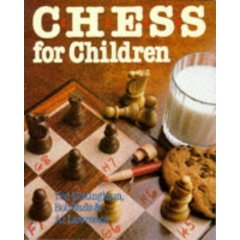
Book Review: Chess for Children

Here is a good book with some great ideas for teaching chess to young and old alike. Although written for children ages 9 to 12, I think its best use is for a teacher or parent wanting to teach a a young child (or anybody for that matter) the game of chess in an easy-to-understand kind of way.

The book succeeds splendidly at this by introducing small “chunks” of chess knowledge. Using a variety of chess game variations, puzzles, and activities, the student gradually learns all the rules of the game in a fun and interesting way.

Take for example “The Pawn Game”. What’s so great about this is that you can begin to play a simplified form of chess having only learned how a single piece moves and captures! Even better, you are actually learning solid chess fundamentals as to how to use pawns in the full game of chess.

In addition to “the Pawn Game” the authors introduce many other “mini” chess activities like the “Attack of the Mad Queen” game and the “Knight Driving Test” challenge.

Because of this approach, learning the rules of chess becomes something fun and not a confusing and overwhelming experience for the new player.

Highly recommended!

Chess for Children (Paperback)


  • by Ted Nottingham, Bob Wade, Al Lawrence
  • Reading level: Ages 9-12
  • Paperback: 128 pages
  • Publisher: Sterling; New Ed edition (June 30, 1996)
  • Language: English
  • ISBN: 0806904534
  • Product Dimensions: 10.0 x 8.0 x 0.4 inches
  • Shipping Weight: 10.88 ounces
  • Average customer review: 4 out of 5 based on 8 reviews

My copy was purchased from http://www.amazon.com/.com re-seller the_book_depository_ltd. To buy from the Amazon listing click this link Used & new then select the "New" tab and you'll see them. Good price - total with shipping from the U.K. was only $13.85. Got it delivered in about 10 days. New and used copies are also available from other re-sellers too.