 I've blogged about David Shenk's excellent book "The Immortal Game" several times (here and here) and I'm happy to say it is now available in a paperback edition ($10.17 from Amazon). If you are looking for a very entertaining chess book you can read away from a chess board this is it. Mostly it is a history of chess, but it also examines why the game has fascinated so many millions over the past millennium or so. You don't even need an understanding of how to play chess to appreciate this book - just an interest. The most technical thing in the entire volume is an on-going examination (between chapters) of the famous "Immortal Game" a chess game played in 1851 by Adolf Anderssen (playing white) and Lionel Kieseritzky. There are plenty of diagrams and easy-to-understand explanations of what is happening in the game. This would be a great book to give someone that may have expressed an interest in chess but, for whatever reason, has been hesitant in taking up the game. Highly recommended!
Friday, October 05, 2007
Rave - "The Immotal Game" Now in Paperback

Tuesday, August 14, 2007
Keep Your Brain Alive
 If you've read my profile, you know one of the reasons I decided to take up chess again was for the good of my brain. Recently, PBS Television has started a new series called Life (Part 2) for those of us approaching (or past) the age of fifty. On the show there has been a lot of good advice on how to exercise the aging brain to keep it healthy. In one episode, The Aging Brain, Dr. Rudy Tanzi, Ph.D., (a Harvard-trained neurobiologist, and the director of the genetics and aging research unit at the Massachusetts General Institute for Neurodegenerative Disease) was asked how can we keep our brains healthy:
The best way to do this is exercise, both physical and mental. Learn new things, or do routine things in a different way. Take a new route to work, or try golfing or brushing your teeth with your non-dominant hand. (Hey, it just might improve your game!)
As part of the recommendation "do routine things in a different way" Dr Tanzi recommends the book Keep Your Brain Alive - 83 Neurobic Exercises to help prevent memory loss and increase mental fitness by Dr. Lawrence C. Katz.
I purchased a copy of this book and I highly recommend it. It makes for fascinating reading and has dozens of intriguing brain exercises. The 83 exercises given are not logic puzzles or memory exercises but "nuerobic exercises" that "use the five senses in novel ways to make the brain more agile and flexible overall so it can take on any mental challenge, whether it be memory, task performance, or creativity."
Monday, September 04, 2006
ABC News: How Chess Can Help Stave Off Alzheimer's

I was glad to see the game of chess getting some good press this morning - or any kind of press for that matter :-) - on the September 4, Labor Day edition of ABC's "Good Morning, America."
The lead in to the segment was "It is one of the most beloved games in the world... and it [may help] to prevent Alzheimer’s disease..."
The interview was with best-selling author David Shenk, who has written a new book on the history of chess titled "The Immortal Game." He has also written a book on Alzheimer's disease. When asked about the connection between the two he responded:
"Everyone in the Alzheimer's community is searching for a way to prevent Alzheimer's and it turns out that one important way - it's not a sure fire way - but you need to use your brain. As you get older, particularly, you need to exercise your brain in any way and the more exercise you get in your brain - it's just like keeping fit and keeping your body fit - the better off you are, the better chance you stand for preventing diseases like Alzheimer's.”
“Chess turns out to be a particularly good brain builder for this..."
Here's an excerpt from the http://www.abcnews.com/ web site:
How Chess Can Help Stave Off Alzheimer's
Writer David Shenk Traces the History of Chess in 'The Immortal Game'
Sept. 4, 2006 — In a wide-ranging examination of chess, David Shenk uncovers the hidden history of a game that was invented in India around 500 A.D. and seems more popular than ever today.
From its enthusiastic adoption by the Persians and its spread by Islamic warriors, to its 21st century importance to the development of artificial intelligence and use as a teaching tool in inner-city America, chess has been a omnipresent factor in the development of civilization.
Research shows that brain is much like the body — it needs continual activity to remain strong and supple and fight off the predations of old age. And researchers have determined that chess is uniquely well-suited to "exercising" the brain. It is simple to play, but offers nearly limitless variation.
It requires memory, problem-solving skills, abstract thought, and creativity. And it turns out that the people who play it regularly in their older years — along with related activities like crossword puzzles — are less likely to develop Alzheimer's and related conditions.
You can read the entire article and an excerpt for Shenk's new book "The Immortal Game" here: How Chess Can Help Stave Off Alzheimer's.
The author's website can be found here: "The Immortal Game"
The book can be ordered here: The Immortal Game: A History of Chess, or How 32 Carved Pieces on a Board Illuminated Our Understanding of War, Art, Science and the Human Brain (Hardcover) by David Shenk
Friday, August 25, 2006
Why Should You Play Chess? What are the Benefits?
For about a dozen years I was a certified teacher teaching computer skills to children and adults here in the state of Michigan. As a teacher I think chess could and should be just as an important curriculum subject as computer skills, math, social studies, or science. I'd would not be surprised if chess as a subject for students and for baby boomers is really going to take off in the next several years because of the tremendous benefits it can provide. Not convinced? Consider then this comphrehensive list from the Chess Dominion web site:
Chess is a game for people of all ages. You can learn to play at any age and in chess, unlike in many other sports, you don't ever have to retire. Age is also not a factor when you're looking for an opponent --young can play old and old can play young.
Chess develops memory. The chess theory is complicated and many players memorize different opening variations. You will also learn to recognize various patterns and remember lengthy variations.
Chess improves concentration. During the game you are focused on only one main goal -- to checkmate and become the victor.
Chess develops logical thinking. Chess requires some understanding of logical strategy. For example, you will know that it is important to bring your pieces out into the game at the beginning, to keep your king safe at all times, not to make big weaknesses in your position and not to blunder your pieces away for free. (Although you will find yourself doing that occasionally through your chess career. Mistakes are inevitable and chess, like life, is a never-ending learning process.)
Chess promotes imagination and creativity. It encourages you to be inventive. There are an indefinite amount of beautiful combinations yet to be constructed.
Chess teaches independence. You are forced to make important decisions influenced only by your own judgment.
Chess develops the capability to predict and foresee consequences of actions. It teaches you to look both ways before crossing the street.
Chess inspires self-motivation. It encourages the search of the best move, the best plan, and the most beautiful continuation out of the endless possibilities. It encourages the everlasting aim towards progress, always steering to ignite the flame of victory.
Chess shows that success rewards hard work. The more you practice, the better you'll become. You should be ready to lose and learn from your mistakes. One of the greatest players ever, Capablanca said, "You may learn much more from a game you lose than from a game you win. You will have to lose hundreds of games before becoming a good player."
Chess and Science. Chess develops the scientific way of thinking. While playing, you generate numerous variations in your mind. You explore new ideas, try to predict their outcomes and interpret surprising revelations. You decide on a hypothesis, and then you make your move and test it.
Chess and Technology. What do chess players do during the game? Just like computers they engage in a search for the better move in a limited amount of time. What are you doing right now? You are using a computer as a tool for learning.
Chess and Mathematics. You don't have to be a genius to figure this one out. Chess involves an infinite number of calculations, anything from counting the number of attackers and defenders in the event of a simple exchange to calculating lengthy continuations. And you use your head to calculate, not some little machine.
Chess and Research. There are millions of chess resources out there for every aspect of the game. You can even collect your own chess library. In life, is it important to know how to find, organize and use boundless amounts of information. Chess gives you a perfect example and opportunity to do just that.
Chess and Art. In the Great Soviet Encyclopedia chess is defined as "an art appearing in the form of a game." If you thought you could never be an artist, chess proves you wrong. Chess enables the artist hiding within you to come out. Your imagination will run wild with endless possibilities on the 64 squares. You will paint pictures in your mind of ideal positions and perfect outposts for your soldiers. As a chess artist you will have an original style and personality.
Chess and Psychology. Chess is a test of patience, nerves, will power and concentration. It enhances your ability to interact with other people. It tests your sportsmanship in a competitive environment.
Chess improves schoolwork and grades. Numerous studies have proven that kids obtain a higher reading level, math level and a greater learning ability overall as a result of playing chess. For all those reasons mentioned above and more, chess playing kids do better at school and therefore have a better chance to succeed in life.
Chess opens up the world for you. You don't need to be a high ranked player to enter big important competitions. Even tournaments such as the US Open and the World Open welcome players of all strengths. Chess provides you with plenty of opportunities to travel not only all around the country but also around the world. Chess is a universal language and you can communicate with anyone over the checkered plain.
Chess enables you to meet many interesting people. You will make life-long friendships with people you meet through chess.
Chess is cheap. You don't need big fancy equipment to play chess. In fact, all you may need is your computer! (And we really hope you have one of those, or else something fishy is going on here.) It is also good to have a chess set at home to practice with family members, to take to a friend's house or even to your local neighborhood park to get everyone interested in the game.
CHESS IS FUN! Dude, this isn't just another one of those board games. No chess game ever repeats itself, which means you create more and more new ideas each game. It never gets boring. You always have so much to look forward to. Every game you are the general of an army and you alone decide the destiny of your soldiers. You can sacrifice them, trade them, pin them, fork them, lose them, defend them, or order them to break through any barriers and surround the enemy king. You've got the power!
Pasted from: library.advanced.org/10746/reasons.html
Wednesday, August 23, 2006
Hope For Me Yet - At 40, The Brain's Best Years Are Still Ahead!
Need some incentive to take up chess or to reacquaint yourself with the game?
Based on the recommendations from Gene Cohen, M.D., PH.D from a recent article in Newsweek, playing chess accomplishes at least 4 of the five recommendations on his list - 5 if you include "chess boxing." :-D
Research has identified several types of activity that can, if practiced regularly, help boost the power, clarity and subtlety of the aging brain.
- Exercise physically. Numerous studies have linked physical exercise to increased brainpower. This is particularly true when the exercise is aerobic—meaning continuous, rhythmic exercise that uses large muscle groups. The positive effects may stem from increased blood flow to the brain, the production of endorphins, better filtration of waste products from the brain and increased brain-oxygen levels.
- Exercise mentally. The brain is like a muscle. Use it and it grows stronger. Let it idle and it will grow flabby. So choose something appealing and challenging—and don't be surprised if, once you start, you want to do more. One of the programs I co-chair, the Creativity Discovery Corps, strives to identify unrecognized, talented older adults in the community. A 93-year-old woman we recently interviewed advised us that she might find scheduling the next interview difficult because she was very busy applying for a Ph.D. program.
- Pick challenging leisure activities. Getting a graduate degree isn't the only way to keep your brain fit. An important 2003 study identified five leisure activities that were associated with a lower risk of dementia and cognitive decline. In order of impact (from highest to lowest), the winners were dancing, playing board games, playing musical instruments, doing crossword puzzles and reading. Risk reduction was related to the frequency of participation. For example, older persons who did crossword puzzles four days a week had a risk of dementia 47 percent lower than subjects who did puzzles only once a week.
- Achieve mastery. Research on aging has uncovered a key variable in mental health called "sense of control." From middle age onward, people who enjoy a sense of control and mastery stay healthier than those who don't. The possibilities for mastery are unlimited, ranging from playing a musical instrument to learning a new language to taking up painting or embroidery. Besides improving your outlook, the sense of accomplishment may also strengthen the immune system.
- Establish strong social networks. Countless studies have linked active social engagement to better mental and physical health and lower death rates. People who maintain social relationships during the second half of life enjoy significantly lower blood pressure, which in turn reduces the risk of stroke and its resulting brain damage. Social relationships also reduce stress and its corrosive effects, including anxiety and depression.
Pasted from <http://www.msnbc.msn.com/id/10753221/site/newsweek/page/3/>
Saturday, August 19, 2006
Why this Blog...
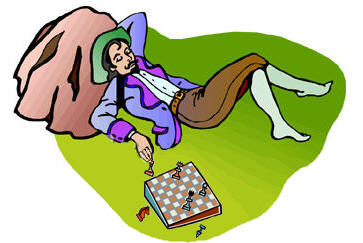 You’ve probably figured out the name of this blog is a take-off on “Rip Van Winkle”. Why? Because just as Rip Van Winkle slept for 25 years as the world went by, as far as chess goes, I have had a similar experience. I have had nothing to do with chess for about 25 years. Although I once really enjoyed chess, ordinary living got in the way and I "resigned" myself to a life without “the game of kings”. What a shame!
But now, for reasons of mental health and general well being, I have taken up chess again. What a joy it is to rediscover the thrill and excitement of the game again after all these years.
So here I am – Rook Van Winkle – awake from my 25 years of chess slumber with this blog detailing my new adventures in the realm of the world’s most fascinating game!
It is my sincere hope that others new to chess, or those like me getting reacquainted with the game will find some entertainment – if not useful information – reading this blog.
If you have any suggestions related to chess improvement (or any observations concerning the posts on this blog) please feel free to add your comments…