Playing to win or playing it safe? Personally, I'd rather take a risk playing for a win than playing not to lose. Coincidentally, yesterday's issue of The Chessville Weekly put it this way, quoting Jean Claude Killy: "To win, you have to risk loss."
My ICC tournament game from today could not be a better example of this philosophy - although I lost the game by taking some risks I almost won. In fact, I missed a forced mate in four after 24. Qxf3 (see diagram). I'll take consolation in the fact I can partially blame time troubles for that as I had 40 seconds left on my clock and just didn't have enough time to confirm and work out the combination. Ah, the joys and sorrows of chess.
Although it is depressing to lose a game, I'm rather proud of the attempt I made to win -sacrificing both a Bishop and a Knight to try and make it happen... and it almost did happen as the following game will show.
After 24. Qxf3 - Black to mate in four:
Tuesday, October 16, 2007
Chess as Played in the Real World - No. 8: Playing to Win


Tuesday, September 25, 2007
Chess as Played in the Real World - No. 7
I've finished the ICC September tournament with a score of 0-4. I lost my last game. I think mostly because I came out of the opening pretty poorly. Well, at least I didn't throw the game away with a complete blunder. Still, it's a bit disappointing not to win (or draw) a single game! I was next to the lowest ranked player (and that player even scored above me thanks to a bye in an earlier round). Here's the game:
Sunday, September 23, 2007
Regal Games from the Realms of Yore - Benjamin Franklin and André Danican Philidor

Today, in our Sunday series Regal Games from the Realms of Yore, we feature Benjamin Franklin - one of the most talented and remarkable men from the annals of history. It should come as no surprise that Franklin was a chess player. Bill Wall has done an admirable documenting information concerning Benjamin Franklin's life long involvement with chess at his web page Benjamin Franklin and Chess by Bill Wall and John McCrary, past president of the USCF and the US Chess Trust has authored an interesting PDF document Chess and Benjamin Franklin: His Pioneering Contributions
That got me thinking whether or not there are any games on record as having been played by Benjamin Franklin. The answer appears to be "no." So, as a substitute I shall have to offer a game by Captain Smith vs François André Philidor, London, England 1790, Bishop's Opening: Berlin Defense (C24), 0-1 which features "a good sample of Philidor's ideas about pawns; plus a nice mating combination at the end." Franklin had the opportunity of meeting and playing chess with Philidor, probably the greatest chess player of the 18th century, at the famous Café de la Régence in Paris.
Tuesday, September 18, 2007
Chess as Played in the Real World - No. 6
It's a little discouraging to be 0-3 in the ICC tournament I'm playing in - but that's what happens when you completely ignore your opponent's threat. I'm still at the stage where I'm playing "hope chess" as Dan Heisman puts it - and until I get by that stage I will continue to have embarrassing losses like this.
Tuesday, September 11, 2007
Chess as Played in the Real World - No. 5
I'm feeling a bit depressed over this loss. Oh, well. I took my time and I tried hard. Hopefully I'm a little wiser. The game is from the second round in the ICC Monthly Tournament for September. I'm playing White.
Tuesday, September 04, 2007
Chess as Played in the Real World - No. 4
For once I can actually post a game I don't need to feel embarrassed about. I'm actually pretty proud of this game - even if I did lose what I believe to be a won game (by making a mistake on move 45). The game is from the first round in the ICC Monthly Tournament for September. I'm playing Black. My opponent is rated a couple hundred points higher than me.
Sunday, September 02, 2007
Regal Games from the Realms of Yore: Morphy vs Duke Karl and Count Isouard 1858
Today, in our Sunday series Regal Games from the Realms of Yore, we feature the first (and so far only the second) game of Paul Morphy that I am familiar with - primarily because it was featured in one of my first chess books (see Rave - The World of Chess).
I'm sure I can't add much to what has been said about this game, but for the novice it's an excellent introduction to Morphy's games - because as Saidy and Lessing said, in The World of Chess, it is a "miniature jewel." I whole-heartedly agree.
One nice thing about being a chess novice (just getting back into chess after 25 years) is I still have ahead of me the whole collection of Morphy's brilliant games to explore and enjoy.
Friday, August 31, 2007
Fridays by the Fireside No. 2 - Odd, But True - Alekhine vs. Four Allies
 This is the second installment of Fridays by the Fireside where I will feature an item of interest from the wonderful Irving Chernev and Fred Reinfeld book The Fireside Book of Chess. Below is the excerpt:
Chapter - The Magic of Chess
Section - Odd, But True
Item - 6
Page - 70
Many a miniature game owes its existence to an early mistake made by one of the players. But when four allies discuss their ideas with each other, and then get mated on the sixth move, that is unique.
Tuesday, August 28, 2007
Chess as Played in the Real World - No. 3
In our last installment I featured a short "skittles" game I played with Judy in which I was checkmated in 8 moves (Chess as Played in the Real World - No. 2). We played four games that day, and it is only fair to include the last game we played - which she won! If you're a novice player, I'm sure you will relate to a game like the one below - where "defeat is snatched from the jaws of victory." Play through the game - and then see the advice at the bottom:
Some comments:
- I'm pretty sure 6. Bxf7+ is unsound, but I'm playing my opponent and not the board (bad!) and I figure it will be interesting to see what this accomplishes - if anything (bad again!) - I need to take the time to think through all the ramifications.
- 15. Re6. Wanting to pressure the defending rook (or exchange it away), I foolishly miss the fact that the c8 Bishop is attacking the e6 square too! Argh!
- 17. Bf5. Not even looking at the danger the rook poses. Well, I deserve what I got.
There are several lesson to be learned from this game - each of which Dan Heisman addresses in his remarkable book “Everyone’s 2nd Chess Book”:
- Think and take your time! Dan Heisman calls this "Guideline Zero" because "all other guidelines are useless if you don't follow this one!" So true.
- "Think with your head, not with your hands."
- Before each move make sure ALL your pieces are safe (including the king!) Duh!
Note: Dan Heisman is the host of the ICC’s radio show “Ask the Renaissance Man”, writes the “Novice Nook” column at ChessCafe.com, and is a Full-Time chess Instructor, and is the author of 8 chess books. If you are a novice player, visit some of the links above. You really should take advantage of Dan Heisman's expert advice aimed directly at the chess novice.
Look for the next installment of the series Chess as Played in the Real World each Tuesday.
Sunday, August 26, 2007
Regal Games from the Realms of Yore: La Bourdonnais vs McDonnell 1834
Today, in our Sunday series Regal Games from the Realms of Yore, we feature the famous fiftieth game of the McDonnell-La Bourdonnais Championship Match of 1834. Wikipedia says of the match:
It was the first match of any importance in the history of chess and is still referred to today as the World Championship of 1834. The games were published widely, and were annotated and discussed by enthusiasts all over Europe. In the course of the mammoth encounter, both players introduced several innovations, a few of which are still seen today. It might even be said that the modern era of chess began with the McDonnell-La Bourdonnais match of 1834.
Like the first game in the Regal Game series (Celebrated Chess Games from History - Stefan Levitsky vs Frank James Marshall 1912), this is one of the earliest "classic" games I remember playing through. The game was included in the Random House book The World of Chess by Anthony Saidy and Norman Lessing, which is where I came across it in 1974.
Like Chernev and Reinfeld did earlier, Saidy and Lessing hooked me into playing over this game with an intriguing statement:
McDonnell sacrifices his queen on the 13th move, a sacrifice that only leads to fruition twenty -three moves later.
White resigns - he is helpless against the threat of ...Ng2 check followed by ...Rh3 mate.
The authors conclude:
Beyond inserting a number of exclamation points it is useless to try and analyze the wildly uninhibited game. Howard Stauntion, the famous English player, made the attempt some years later, only to give up with the historic remark: "It seems uttertly impossible for either player to save the game!"
Friday, August 24, 2007
Fridays by the Fireside No. 1 - Odd, But True - Weiss vs. Schwartz
 This is the first installment of Fridays by the Fireside where I will feature an item of interest from the wonderful Irving Chernev and Fred Reinfeld book The Fireside Book of Chess. Below is the excerpt:
Chapter - The Magic of Chess
Section - Odd, But True
Item - 121
Page - 107
A chess game where White and Black play perfectly theoretically should end in a draw. Theory should be strengthened when the players themselves are named White and Black! In the Nuremberg tournament of 1883, Weiss (which means White) met Schwartz (which means Black) in the fifth round. This is what happened:
After 27... Bxd4 the game was called a draw. Appropriately enough, the positions of 'White and Black (or Weiss and Schwartz) are completely identical!
Tuesday, August 21, 2007
Chess as Played in the Real World - No. 2
I've been encouraging Judy to take up the game of chess, and ocassionally I can get her to play a game or two with me. Below is an amusing little game we played in June. I know I should go gentle on her but the killer instinct is too strong :-) To see the first entry in this series go here.
[Event "Skittles Game"]
[Site "Home"]
[Date "2007.06.21"]
[Round "1"]
[White "Judy"]
[Black "RookVanWinkle"]
[Result "0-1"]
[Opening "Tennison (Lemberg, Zukertort) gambit"]
[ECO "B01"]
[NIC "VO.17"]
1. e4 d5 2. Nf3 dxe4 3. Nh4 e5 4. d3 Qxh4 5. dxe4 Bc5 6. Qd5 Qxf2+ 7. Kd1Bg4+ 8. Be2 Qxe2#
Sunday, August 19, 2007
Celebrated Chess Games from History - Stefan Levitsky vs Frank James Marshall 1912

David Shenk, in his excellent book The Immortal Game describes how, in an attempt to improve his game, he needed to "seek some expert help." As part of that quest he came upon a book of famous chess games, and from there upon one game in particular - "The Immortal Game" by Adolf Anderssen vs. Lionel Kieseritzky played June 21, 1851 in London.
For me, the first classic game I stumbled upon, after first learning the game of chess, was "Levitzky vs. Marshall", Breslau 1912. Why this particular game? Well, the book I was reading made this statement:
The most brilliant move ever seen on a chessboard was made by Frank J. Marshall, in a game against Levitzky. So electrifying was the effect on the spectators that they showered his board with gold pieces!
I had never played through classic game up to that point (I was about 9 or 10 years old), but with a claim like "the most brilliant move ever seen on a chessboard" and the mention of gold pieces being showered on the board I was hooked. This I had to see.
What a game! Marshall's last move consisted of a stunning queen sacrifice, seemingly out of the blue, allowing Levitsky to capture it in three different ways! Even with my limited understanding of chess I could appreciate the shock such a move must have created. Here is the game:
1.d4 e6 2.e4 d5 3.Nc3 c5 4.Nf3 Nc6 5.exd5 exd5 6.Be2 Nf6 7.O-O Be7 8.Bg5 O-O 9.dxc5 Be6 10.Nd4 Bxc5 11.Nxe6 fxe6 12.Bg4 Qd6 13.Bh3 Rae8 14.Qd2 Bb4 15.Bxf6 Rxf6 16.Rad1 Qc5 17.Qe2 Bxc3 18.bxc3 Qxc3 19.Rxd5 Nd4 20.Qh5 Ref8 21.Re5 Rh6 22.Qg5 Rxh3 23.Rc5 Qg3!! 0-1
To this day, I remember it fondly as the first "classic game" of chess I ever played over.
What was your first memorable classic game?
UPDATE: I found an interesting discussion about the legend that "spectators showered the board with gold pieces" in a discussion in the Kibitzer's Corner at www.chessgames.com/:
"It is not strange that a game as old as chess should have its fabulous legends. Columbus's voyage to America, for example, according to one tale, would not have been possible had not King Ferdinand of Spain managed to retrieve a lost game (with the assistance of one of Columbus's well-wishers). A battle in the Revolution could have been won had a British general not pocketed a note during a chess game, in which he was much absorbed, warning him of the approach of the Americans. One myth has made the rounds so often that it has gained wide currency through reiteration, even though there isn't a grain of truth in it. It concerns the famous brilliancy at Breslau in 1912 in the game Marshall-Lewitzky [sic]. On his twenty-third move, the late U.S. champion won fantastically by subjecting his Queen to capture in three different ways on one move. This was dubbed the most beautiful move ever made on the chessboard. Enthusiastic spectators are alleged to have showered the board with gold pieces. But Caroline Marshall, who ought to know, disclaims knowledge of even a shower of pennies." I.A. Horowitz, All About Chess, 1958.
And this follow-up comment:
Its difficult to know for sure, but Caroline Marshall is probably right. Andrew Soltis in Frank Marshall, Chess Champion (McFarland, 1994) had Marshall's original notes for the "My Fifty Years in Chess". Marshall says only that he received "a purse" after the game. Why did he get money after the game? Apparently, some Russian nationals like P.P. Saburov and Alekhine bet that their countryman Levitsky would win. After the game, they dumped their coins on board to pay off Marshall. The story was recounted by Walter Korn in American Chess Heritage. Korn was not present but told the story as it was circulated around Europe.
Still, why didn't Caroline Marshall see the payoff? And why did Marshall after the publication of the book insist that the shower of gold story was true? The rumor has always been that Fred Reinfeld helped with My Fifty Years in Chess, so perhaps it was he who exaggerated the facts a bit and Marshall simply loved the idea.
Monday, February 05, 2007
Chess as Played in the Real World - No. 1

[Event "Family Skittles Game"]
1. e4 e5 2. d4 d6 3. d5 Be7 4. Nf3 Bg4 5. Bb5+ Nd7 6. O-O Nh6 7. Qd2 O-O 8.Ng5 Bxg5 9. Qxg5 Nf6 10. f3 a6 11. fxg4 axb5 12. h4 Nhxg4 13. h5 h6 14. Qf5 Qd7 15. Bxh6 gxh6 16. Nd2 Rad8 17. Rf3 b4 18. Rg3 Qb5 19. Rxg4+ Nxg4 20.Qxg4+ Kh8 21. Rf1 Qc5+ 22. Kh2 Qxc2 23. Rf6 Rd7 24. Rxh6#{White mates} 1-0
Tuesday, September 26, 2006
Rook Takes First Place in OTB Tournament!
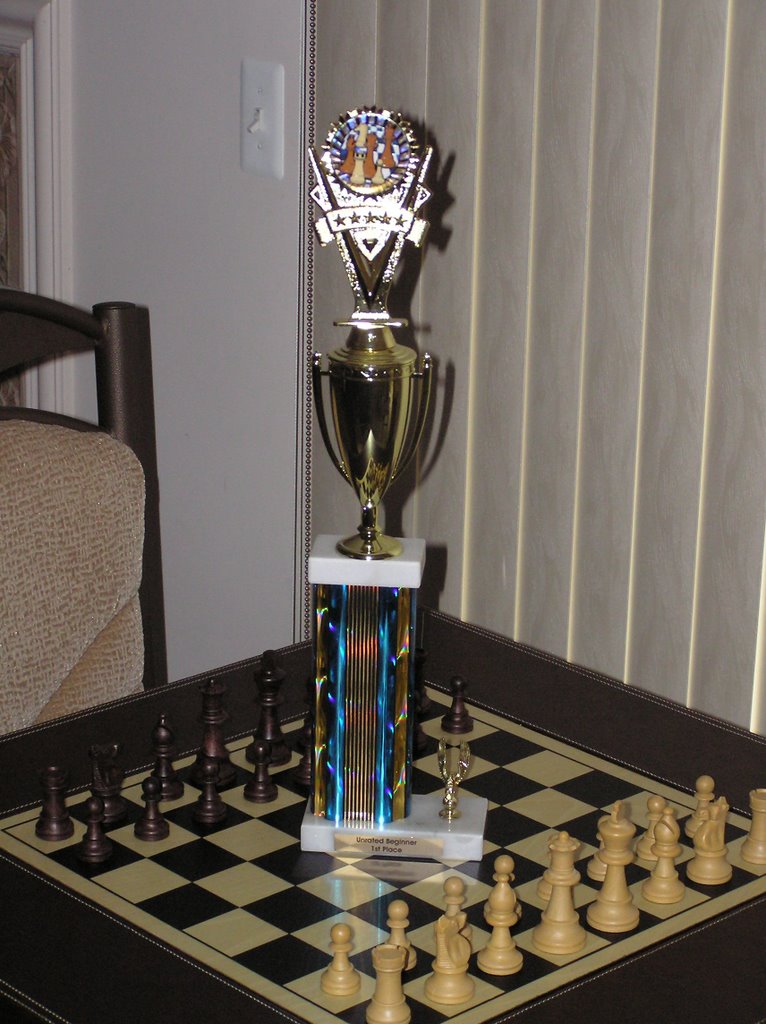 In 1979 I took first place with a 4-0 finish in the 1979 Beginners/Unrated section in the 2nd Annual Pontiac Open Chess Tournament. That was my first and only tournament experience until just a few months ago.
History repeats itself. On Saturday, September 16th, twenty-seven years later, I took first place 4-0 (shared with another 4-0 finisher) in the "All the King's Chessman's" Beginner's Unrated Chess Tournament. Unlike last time where I only got a cash prize, this time I did get a trophy! (See picture).
To be fair, the pairings worked in my favor. Although there were four or more adults entered, in rounds 1-3 I was paired with a novice teenager, a 5-year old, and a 10-year old. In the last round I played board 2 against an adult player. Since my game finished quickly, I had an opportunity to view board 1. I'm pretty certain if I had been paired with either player from board 1 they would have trounced me - it was obvious by the way they played they were very experienced chess players.
Here is my winning game from the last round:
Opening "Scandinavian (Center Counter) Defense"
ECO "B01"
White "James M. (Rook Van Winkle)"
Black: "Rod B."
1. e4 d5
2. e5
I have no idea what opening this is. I decline the pawn offer and push forward to prevent Nf6 and to follow up with d4. The opening information above is what the ICC reports it is.
2. ...Nc6
3. d4 e6
4. Nf3 Bb4+
5. c3
The bishop will retreat and I will continue an advance in an attempt to trap it.
5. ...Ba5
6. b4 Bb6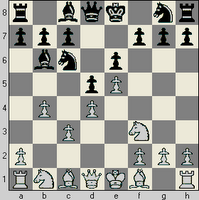
7. b5
If not the bishop, hassle the knight. I know I am probably violating opening principles by making all these pawn moves and ignoring piece development - but I can't resist the temptation.
7. ...Nce7
8. Ng5
I move here just because I can. It will annoy black and threaten the f7 square, especially if I can follow up with 9. Qf3.
8. ...h6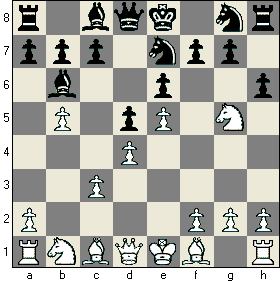
With 8. Ng5 I didn't even think to consider what black's response would be - I'm still very much playing like a beginner! I was annoyed at moving the knight there only to have to move it a second time to safety. It was at this point I found something interesting that I had not planned for at all.
9. Qh5!?
Threatening the f7 square with the queen. Black can now take the knight with the pawn, but he is loath to give up the rook after 9. ...hxg5 10. Qxh8.
9. ...Nf5??
Just about the worst move black could make since the d7 flight square will be lost with the displacement of the knight from e7.
10. Qxf7#
P.S. In the 1979 tournament I checkmated my last opponent in 12 moves - a bit surprising considering my opponent had won his previous 3 games. In this tournament I checkmated my last opponent, who also won his first three games, in only 10 moves. It was SPOOKY that I won so quickly because it felt exactly like a moment in time had repeated itself. Unfortunately I cannot credit any great skill or technique on my part in either win – it really was more a case of my opponents losing their games :-)