 I've blogged about David Shenk's excellent book "The Immortal Game" several times (here and here) and I'm happy to say it is now available in a paperback edition ($10.17 from Amazon). If you are looking for a very entertaining chess book you can read away from a chess board this is it. Mostly it is a history of chess, but it also examines why the game has fascinated so many millions over the past millennium or so. You don't even need an understanding of how to play chess to appreciate this book - just an interest. The most technical thing in the entire volume is an on-going examination (between chapters) of the famous "Immortal Game" a chess game played in 1851 by Adolf Anderssen (playing white) and Lionel Kieseritzky. There are plenty of diagrams and easy-to-understand explanations of what is happening in the game. This would be a great book to give someone that may have expressed an interest in chess but, for whatever reason, has been hesitant in taking up the game. Highly recommended!
Friday, October 05, 2007
Rave - "The Immotal Game" Now in Paperback

Monday, September 17, 2007
Rook's Rudimentary Resources - Bobby Fischer Teaches Chess
 Bobby Fischer Teaches Chess has gotten a lot of criticism, from complaints that it was "ghost written" (i.e. Margulies and Mosenfelder wrote it while Bobby just lent his name) to condemnation that this book doesn't really teach you chess. I don't disagree - both these criticisms are well taken - and yet I still think it is ONE of the best books to read for the absolute chess novice.
Without an understanding of checkmate, most beginner's lose track of the ultimate object of the game and aimlessly move their pieces around or gleefully try to capture ever piece within range. Reading this book, after having learned how the pieces move, will help focus a new player on the real goal of the game - the ultimate checkmate of the opponent's king.
So let's be clear about this. If you are looking for a single book that "teaches chess" this is NOT it. This book does not even TOUCH on the subjects of algebraic notation or opening principles or simple endgame positions. If you already know a bit about chess and what checkmate is and how to do it, again, this book is NOT for you. However, if you have JUST learned how the pieces move, and you need to understand ultimate the object of the game - checkmate and how it is achieved - THIS IS the book for you.
The book really should be titled Bobby Fischer Teaches Checkmate. This would be an accurate title that would squelch the main (and truthful) criticism of the book - that it fails to teach you all you need to know to play chess. But it does do a great job of making sure you understand what checkmate is and how it is accomplished. You also learn some of the basic tactics - pins and forks and the like - that are put to use in the process of giving checkmate.
So learn how the pieces move first and then, with the aid of this excellent book, learn the goal of the game. Once you have done that, you can then proceed to learn more of the basics with a general purpose instructional book on chess. More on those books later...
Tuesday, September 11, 2007
Chess as Played in the Real World - No. 5
I'm feeling a bit depressed over this loss. Oh, well. I took my time and I tried hard. Hopefully I'm a little wiser. The game is from the second round in the ICC Monthly Tournament for September. I'm playing White.
Monday, September 10, 2007
Rook's Rudimentary Resources - Online Chess Databases
 "Chess is an aesthetic experience – the more you understand, the more you enjoy the beauty of this game."
One of the best ways to appreciate the "aesthetic experience" AND improve at chess is by studying the games of great players. Here are several FREE Internet chess database collections which will give you a wealth of great chess games to explore:
- ChessGames.com. ChessGames.com is a web-based chess database and community. It contains over 400,000 searchable chess games and offers daily features, such as a "Game of the Day" and a "Puzzle of the Day", taken from games in the database. There is also a "Premium Membership" ($25 annually) which adds access to numerous features including a "Guess-the-Move" chess training tool and the Opening Explorer, Endgame Explorer, and Sacrifice Explorer.
- ChessLab.com. A collection of "two million interactive chess games online (1485 - 2006)" which you can search and analyze online. Also included is a puzzle section which includes things like "find mate in 2" and "find the best move."
- ChessBase Online. This is a high quality database of 2.4 million unannotated chess games that is kept updated with new and historic games on a weekly basis.
- NICBase Online. Sponsored by New in Chess, this online database features "over 1.25 million chess games." Online consists of 4 major functions: Searching for a game, Classifying a game, Browsing through NIC-Key Tree, and Viewing a game.
- MonRoi World Databank of Chess Free database of recent tournament games.
If you have a PGN file viewer or a chess database program for managing games (e.g. ChessBase or Chess Assitant) you can also download complete collections of chess games in a PGN file format to your PC. For more recent games, Convetka has a good collection here.
Thursday, September 06, 2007
Rook Recommends - Chessmaster 10
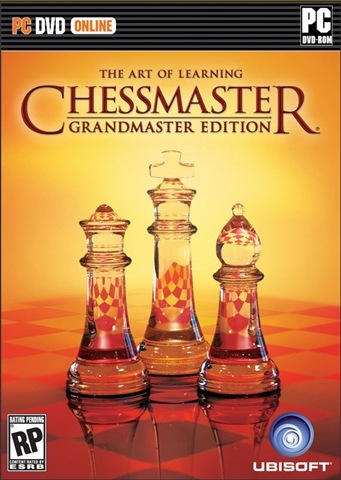 NEWS FLASH! Two new versions of Chessmaster are on their way in October 2007 (the current version, Chessmaster 10, was released in 2004 - so we're long over due for an update). They are Chessmaster: Grandmaster Edition for Windows PC and Chessmaster: The Art of Learning for the Nintendo DS.
Some highlights of the new edition:
- PC Version on DVD - presumably to facilitate the large chess instruction video files presented by Josh Waitzkin
- Annotated Famous Games: Players have access to 900 of the most important chess games, which are analyzed to provide key tactics
- An Additional Chess Game Database of 600,000 games
- Chess Variants:
- Dark Chess, in which the opponent’s pieces are invisible
- Extinction Chess, where the winner is the first player to capture all of the opponent’s pieces
- Losing Chess, a game that rewards the first player to lose all of his/her pieces!
- 6 "Mini Games"
- Minefield, in which chess pieces are used to locate mines hidden in the board
- Breaking the Lines, where the knight is moved to capture all of the pawns
- Fork My Fruit, a game that uses chess pieces to fork fruit of the same kind
- Wireless Play - The Nintendo DS version features wireless play with other DS owners
...Now back to Rook's Recommendations for Raising Ratings:
Today in our Thursday series, Rook takes a look at Chessmaster 10.
For only $20 (here at Amazon.com) it's hard not to recommend this program. There are plenty of other chess playing programs Fritz, Hiarcs, Junior, Shredder, but it would be a mistake to turn down one's nose at this consumer product - especially if you are novice.
Now, I'm not a fan of playing chess against the computer (see Why I Hate Playing Computer Chess!) so my reason for recommending Chessmaster is mostly for it's educational value. In particular you get the following useful tools:
- Chessmaster Academy: Josh Waitzkin's Academy. This is the featured (and largest) tutorial.
- Chessmaster Academy: Larry Christiansen Attacking Chess. Annotated games of "classic chess battles."
- Chessmaster Academy: Chessmaster Series. Some of the many topics:
- Beginning Strategy by Yasser Seirawan
- Opening Moves by Bruce Pandolfini
- Basic Themes by Bruce Pandolfini
- Larry Evans Endgame Quiz
- Diagnostic Rating Exam by Bruce Pandolfini
- Match the Masters by Bruce Pandolfini
- John Nunn's Favorite Puzzles
- Opening Practice
Many of the introductory lesson are narrated. This is especially useful to new or younger players as they hear the correct pronunciations of terms like en passant, FIDE, Ruy Lopez, etc. I could have used that kind of help when I was a kid as I had no adult chess players to learn from.
Of course, you can play chess with this program too - both against the computer and online - although I would recommend other online chess playing sites like the ICC or FICS over what Chessmaster offers.
All-in-all, I think this is the best $20 a novice could spend on chess software.
NOTE: If you look at the average review rating at Amazon you might think this was only an average program with a 3-star rating. However, the reason for the low score is primarily due to the obnoxious copy-protection the original release had (weed out the reviews complaining about that and the program is more like a 4 or 5 star rating) Fortunately, Ubisoft has redeemed themselves by removing the copy-protection when you install the latest patch for the game.
Tuesday, September 04, 2007
Chess as Played in the Real World - No. 4
For once I can actually post a game I don't need to feel embarrassed about. I'm actually pretty proud of this game - even if I did lose what I believe to be a won game (by making a mistake on move 45). The game is from the first round in the ICC Monthly Tournament for September. I'm playing Black. My opponent is rated a couple hundred points higher than me.
Monday, September 03, 2007
Rook's Rudimentary Resources - Chess Score Sheets
 In the 2nd installment of our series, Rook's Rudimentary Resources, we look at score sheets. Yes, the humble chess score sheet.
Earlier I mentioned (Advice for the Chess Novice - Improve Your Game for Free! ) that in order to improve your chess it is essential to record all your games. If you're playing at your computer or over the Internet it's likely your moves are already being recorded - if not make sure you turn on that feature. When playing Internet chess at the ICC for example, you can configure both the Blitzin and the Dasher software to log all your games to a PGN file or even have them e-mailed to you after each game.
But if you really want form a good habit, and improve your chess at the same time, try recording your games using paper-and-pencil even though you are at the computer. There are several good reason for this because it will help you:
- Learn notation better (or faster if a beginner)
- Re-enforce good habits for over-the-board (OTB) play
- Force you to play just a little bit slower (which is a good thing)
- Allow you to remember and learn from your game better.
Studies show the more of your senses you involve in an activity the better you learn - there's a whole book written about this which you can read about in my blog entry entitled Keep Your Brain Alive
As for actual over-the-board play, with all the technology today, you'd think there'd be alternative methods developed for recording our moves -- and you'd be right. The problem is, unless you've recently won the lottery, you're not going to be able to afford the MonRoi Personal Chess Manager at $360, or even more extravagantly, never worry about recording a game ever again with the $700 DGT Projects - DGT Electronic Chessboard. BTW, Santa, if you ever win the lottery and you are feeling generous, Rook will gladly take one of these for playing his games on the ICC ;-)
In the meantime, you'll need to record your games the old-fashioned way - using paper and pencil. You can purchase bound score sheet pads (Google "Chess Supplies" or "Chess Tournament Supplies") or find plenty of free ones for downloading (Google "Chess Score Sheets"). If you have trouble finding one, here's a simple paper-saving one from ChessAssistance.com you can download as a PDF format and print out (requires the free Adobe Acrobat Reader required).
There was a time when you could buy chess score notebooks with refillable pages. These were great - you could rearrange the pages or insert dividers to help organize your games. Sadly I'm not aware of anyone making them anymore.
I've saved the best option for last - and the one I think offers the best benefit all-around: individual 5" x 8" carbonless copies score sheets. You can find them at The United States Chess Federation store at a reasonable price of $11.95 for 200 sheets.
OK, these are used for tournaments, why would I use them to record my own personal games? Here, I think, are two very compelling reasons.
First, since they are individual pages you can rearrange them anyway you like. Buy yourself a 5' x 8" three-ringer binder and a hole-punch and your set to go.
It's the second reason, though, that makes it really compelling - the carbonless copy. The second copy can be very valuable - not necessarily to you but to your opponent. Here's why:
- If you are playing somebody who is into chess (like you) they are probably recording there games too. However, since we all seem to be prone to making score sheet mistakes it's great if you can compare your score sheet with that of your opponent. That's where that carbonless copy comes in - just hand it to them and they are set.
- If you are playing someone new to chess, chances are they are not recording the moves of their game. Chances are too that you are also trying to sell them on the fun and benefits of chess. So when the game is over you hand them the carbonless copy. Of course, it might look like Greek to them, but you've given them something that just might spark an interest in chess. Sure they might throw it away, they might hang on to for awhile and then throw it away, or they might actually keep it, and maybe someday, be curious enough about the game of chess and that mysterious piece of paper you gave them to actually learn the game and to eventually decipher that mysterious score sheet. If they do ever do that and take up chess that score sheet might even be something they treasure.
Thursday, August 30, 2007
Advice for the Chess Novice - Improve Your Game for Free!
 In today's Thursday series, Rook's Recommendations for Raising Ratings, I'm going to suggest you save some cash (at least for now) by taking some free advice rather than spending your money on all the enticing chess books, videos, software, and paid services (like hiring a chess coach or enrolling in an on-line tutorial subscription service) out there.
1. Play Chess! My first recommendation is the most obvious -but surprisingly often overlooked. Play chess. Play more chess. Play everyday. Like a musician learning to play an instrument, without regular practice you are not going to be very good. Fortunately we live in the age of the Internet, so finding an opponent to play (for free) is a piece of cake. Read Starting out with Online Chess Play to get started. And don't forget the Internet is not the only place to play - there are other excellent options: Where to Play Chess : Introduction. And don't make excuses for not playing chess.
2. Record All Your Games Assuming you have learned chess notation, you should be recording all your games. It's important to learn from your mistakes - you need to be able analyze your games in order to determine what you did right or what you did wrong. The other great reason to record all your games is that you'll be able to revisit them years later so you can appreciate just how much you have improved or to wistfully reflect on that win over your opponent who was rated 300 points higher than you.
3. Use the free chess resources on the web. There is a mind-boggling amount of chess improvement stuff on the Internet, which you can easily find using a Google search. Finding chess resources is not the problem- picking a few select sites to begin with is (Rook Van Winkle's Chess Blog being a given, of course). Start with these three chess sites and explore them thoroughly before going further afield looking for all the other wonderful and useful chess improvement sites out there:
- Mark Week's About Chess. If you are totally new to chess begin with the "Essentials" section (top left) or better yet, click here to start directly at the beginner's page. Next step, proceed to the Improve Your Game Section.
- Novice Nook. After you have a little experience under your belt it's time to head off to Dan Heisman's "Novice Nook" site. Again, there is the ever present danger of being overwhelmed with too much of a good thing. Fortunately Dan addresses this problem with his First NNs to Read - a list, in chronological order, of the first 12 Novice Nook columns to read.
- ChessVideos.TV. Register at this site and get some free video training, starting with the Beginner's section. There's no easier way to learn than watching.
Tuesday, August 28, 2007
Chess as Played in the Real World - No. 3
In our last installment I featured a short "skittles" game I played with Judy in which I was checkmated in 8 moves (Chess as Played in the Real World - No. 2). We played four games that day, and it is only fair to include the last game we played - which she won! If you're a novice player, I'm sure you will relate to a game like the one below - where "defeat is snatched from the jaws of victory." Play through the game - and then see the advice at the bottom:
Some comments:
- I'm pretty sure 6. Bxf7+ is unsound, but I'm playing my opponent and not the board (bad!) and I figure it will be interesting to see what this accomplishes - if anything (bad again!) - I need to take the time to think through all the ramifications.
- 15. Re6. Wanting to pressure the defending rook (or exchange it away), I foolishly miss the fact that the c8 Bishop is attacking the e6 square too! Argh!
- 17. Bf5. Not even looking at the danger the rook poses. Well, I deserve what I got.
There are several lesson to be learned from this game - each of which Dan Heisman addresses in his remarkable book “Everyone’s 2nd Chess Book”:
- Think and take your time! Dan Heisman calls this "Guideline Zero" because "all other guidelines are useless if you don't follow this one!" So true.
- "Think with your head, not with your hands."
- Before each move make sure ALL your pieces are safe (including the king!) Duh!
Note: Dan Heisman is the host of the ICC’s radio show “Ask the Renaissance Man”, writes the “Novice Nook” column at ChessCafe.com, and is a Full-Time chess Instructor, and is the author of 8 chess books. If you are a novice player, visit some of the links above. You really should take advantage of Dan Heisman's expert advice aimed directly at the chess novice.
Look for the next installment of the series Chess as Played in the Real World each Tuesday.
Monday, August 27, 2007
Rook's Rudimentary Resources - ChessVideos.tv

ChessVideos.TV is a community driven site where anybody can record and upload and videos of themselves playing chess or analyzing games. Of course, our resident chess expert, Josh Specht is always there to provide his expert analysis whether in the forum or through his videos.
Did I mention everything on the site is FREE! All you need to do is register for access to the discussion forums and from there you can view the entire collection of videos - which are organized into the following categories:
- Beginner's Videos
- Int/Advanced Videos
- Game Analysis Videos
- Endgame Lesson Videos
- Chess Puzzle Videos
Our secret is to embed the videos directly in the forum, so you can conveniently view and discuss the videos at the same time!
There is a lot of interesting stuff here. Of course, the quality of the material varies quite a bit (both the presentation and the information) but this is to be expected given the "community' nature of the site. Even so, you are bound to find some items that will not only entertain you, but educate you at the same time. With the recently added live "chat room" and the ability to search for a particular video the site keeps getting better.
In addition to the videos, you'll also find a "puzzle of the day" and a set of very useful chess blogging tools:
- Puzzle of the Day - An interactive chess puzzle (you can make the moves right on the board). Currently, there are over 100 "Past Puzzles of the Day" you can also try.
- Diagram Generator - Simply set up the pieces on the board (or generate them from FEN) to create a Chess Diagram which you can add to your blog (the resulting chess diagram is hosted on the ChessVideos.tv server and you then link to it).
- Game Replayer - Paste your PGN chess game into the text box and your are given a link to play back your game using their replayer, or you can post the game in their forums, or you can grab some code to display the game on your blog or website (Like the diagrams, the games are hosted on their servers permanently - the won't be deleted unless you ask.)
- Puzzle Creator - Uses a wizard to set up and generate a chess puzzle - complete with hints. You can replay the puzzle from their link or grab the code to use in your blog or website.
- Qoute of the Day - "Every day we will pick a new chess quote, which you can insert right into your web page or blog. Inserting it is simple and every day it will update automatically with a fresh quote!" Cool - I'm using it now - look in the upper left of this blog page.
Look for the next installment of the series Rook's Rudimentary Resources each Monday.
Tuesday, August 21, 2007
Chess as Played in the Real World - No. 2
I've been encouraging Judy to take up the game of chess, and ocassionally I can get her to play a game or two with me. Below is an amusing little game we played in June. I know I should go gentle on her but the killer instinct is too strong :-) To see the first entry in this series go here.
[Event "Skittles Game"]
[Site "Home"]
[Date "2007.06.21"]
[Round "1"]
[White "Judy"]
[Black "RookVanWinkle"]
[Result "0-1"]
[Opening "Tennison (Lemberg, Zukertort) gambit"]
[ECO "B01"]
[NIC "VO.17"]
1. e4 d5 2. Nf3 dxe4 3. Nh4 e5 4. d3 Qxh4 5. dxe4 Bc5 6. Qd5 Qxf2+ 7. Kd1Bg4+ 8. Be2 Qxe2#
Thursday, August 16, 2007
Play "Cooperative Chess" at Work

I was certain that the game of chess would be mentioned in the excellent book Keep Your Brain Alive - 83 Neurobic Exercises to help prevent memory loss and increase mental fitness by Dr. Lawrence C. Katz and Manning Rubin. (You can read my blog entry about the book here: Rook Van Winkle's Chess Blog: Keep Your Brain Alive)
Sure enough, on page 83 they recommend using an "ongoing chess game" at work as one of their exercises for "preserving and enhancing the brain's capabilities into the senior years."
Basically the idea is to set up a chess game near the water cooler (or some other public place were co-workers gather) "where an employee can come to the board, assess the situation, and make a move."
Although this doesn't allow for the development of long term strategies, according to the authors of the book:
... It does require visual-spatial thinking that is different from what most of us do at work. The brief gear switching provides a break from verbal, left-brain activities and lets the 'working brain' take a breather."
I think this is a fantastic idea! You will need some method to indicate whether it is white's or black's turn to play.
Why not use this as a great way to get a chess club started at your work? It would certainly attract the attention of any chess playing co-workers, and the novelty of the 'shared game" might even spark some interest among your non-chess playing co-workers - perhaps they might even want to take up the game themselves?
Monday, July 30, 2007
Learn to Play Chess (and Practice Basic Checkmates!) for Free on the Internet
Here are the details courtesy of the United States Chess Federation (USCF) website:
Here is a great free service offered by Chess Magnet School in conjunction with the U.S. Chess Federation and sponsoring chess coaches. Using this website you can "learn to play chess according to the official rules, to play against the computer, and to practice your checkmates."
Also be sure to check out (pun intentional) the USCF's "New to Chess" section for more great information on learning about the "Game of Kings."Learn to Play Chess Interactively!
In conjunction with the USCF, Chess Magnet School is offering an interactive program to teach you chess. Practice until you're good enough to play a real game! Discounts for more advanced chessmagnetschool programs are also avaliable for USCF members. Learn the Rules of Chess on chessmagnetschool.com.
Note: "Rules of Chess" requires Java 1.3 or above. Be patient- It may take a full minute to load. If you get a white screen, visit Java.com and upgrade your version of Java (which is free), and/or check your browser settings to make sure Java is enabled.
Monday, February 05, 2007
Chess as Played in the Real World - No. 1

[Event "Family Skittles Game"]
1. e4 e5 2. d4 d6 3. d5 Be7 4. Nf3 Bg4 5. Bb5+ Nd7 6. O-O Nh6 7. Qd2 O-O 8.Ng5 Bxg5 9. Qxg5 Nf6 10. f3 a6 11. fxg4 axb5 12. h4 Nhxg4 13. h5 h6 14. Qf5 Qd7 15. Bxh6 gxh6 16. Nd2 Rad8 17. Rf3 b4 18. Rg3 Qb5 19. Rxg4+ Nxg4 20.Qxg4+ Kh8 21. Rf1 Qc5+ 22. Kh2 Qxc2 23. Rf6 Rd7 24. Rxh6#{White mates} 1-0
Tuesday, October 17, 2006
Chess Improvement Plan - Part Two: Taking Inventory
 The Complete Chess Course by Fred Reinfeld. My very first chess book - which I purchased around 1969 or 1970 (as detailed in my post My Early Days with Chess). My original edition long since fell apart - quite literally - all the pages came loose as the glue in the binding cracked. For some reason I kept "Book One - The Basic Rules of Chess" - I still have that chapter stapled together. The rest of the book was eventually discarded. For nostalgia's sake, I went ahead and purchased the current Doubleday edition from Amazon. (The cover jacket illustrated here is the one I remember - which an Internet image search kindly revealed.)
I don't believe I ever got beyond book five or six. But I am enjoying reading it again - amazingly I still remember some of the example games - rather remarkable considering I last read the book in the 1970's! I'm comfortable with the old "descriptive notation" the book uses (1. P-K4 P-QB4 etc.) but it would be nice to have an algebraic edition.
I'm sure they're better books available today - but there is still a lot of good stuff here.
Tuesday, September 26, 2006
Rook Takes First Place in OTB Tournament!
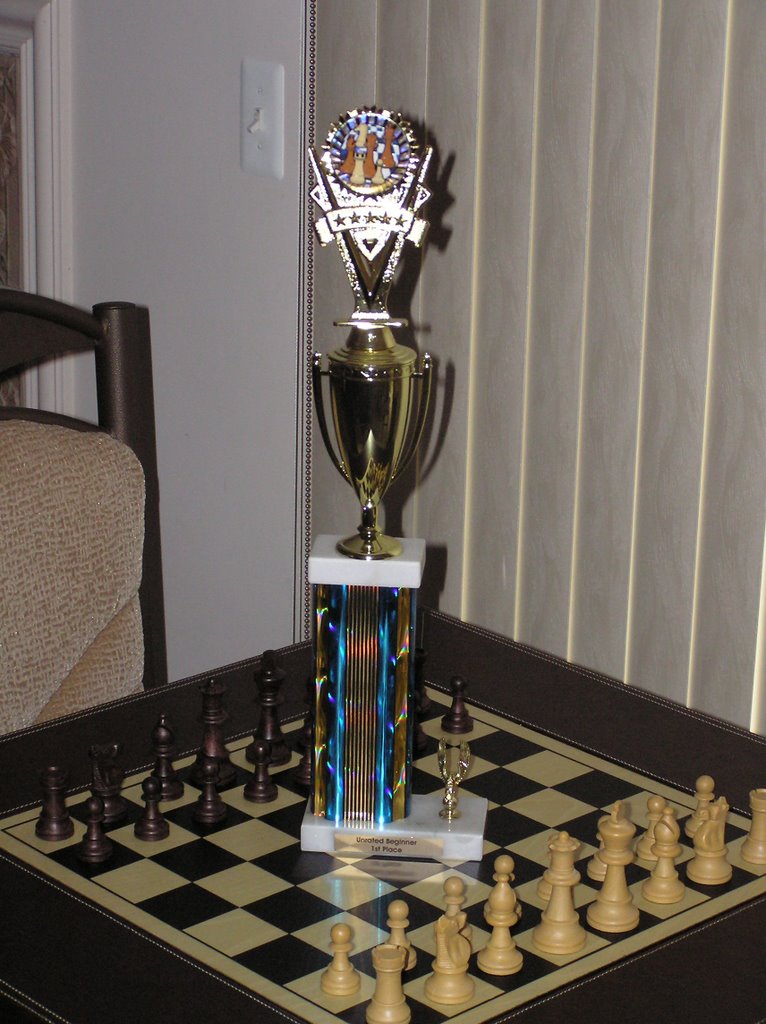 In 1979 I took first place with a 4-0 finish in the 1979 Beginners/Unrated section in the 2nd Annual Pontiac Open Chess Tournament. That was my first and only tournament experience until just a few months ago.
History repeats itself. On Saturday, September 16th, twenty-seven years later, I took first place 4-0 (shared with another 4-0 finisher) in the "All the King's Chessman's" Beginner's Unrated Chess Tournament. Unlike last time where I only got a cash prize, this time I did get a trophy! (See picture).
To be fair, the pairings worked in my favor. Although there were four or more adults entered, in rounds 1-3 I was paired with a novice teenager, a 5-year old, and a 10-year old. In the last round I played board 2 against an adult player. Since my game finished quickly, I had an opportunity to view board 1. I'm pretty certain if I had been paired with either player from board 1 they would have trounced me - it was obvious by the way they played they were very experienced chess players.
Here is my winning game from the last round:
Opening "Scandinavian (Center Counter) Defense"
ECO "B01"
White "James M. (Rook Van Winkle)"
Black: "Rod B."
1. e4 d5
2. e5
I have no idea what opening this is. I decline the pawn offer and push forward to prevent Nf6 and to follow up with d4. The opening information above is what the ICC reports it is.
2. ...Nc6
3. d4 e6
4. Nf3 Bb4+
5. c3
The bishop will retreat and I will continue an advance in an attempt to trap it.
5. ...Ba5
6. b4 Bb6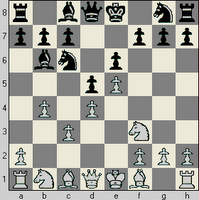
7. b5
If not the bishop, hassle the knight. I know I am probably violating opening principles by making all these pawn moves and ignoring piece development - but I can't resist the temptation.
7. ...Nce7
8. Ng5
I move here just because I can. It will annoy black and threaten the f7 square, especially if I can follow up with 9. Qf3.
8. ...h6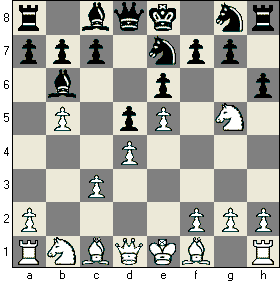
With 8. Ng5 I didn't even think to consider what black's response would be - I'm still very much playing like a beginner! I was annoyed at moving the knight there only to have to move it a second time to safety. It was at this point I found something interesting that I had not planned for at all.
9. Qh5!?
Threatening the f7 square with the queen. Black can now take the knight with the pawn, but he is loath to give up the rook after 9. ...hxg5 10. Qxh8.
9. ...Nf5??
Just about the worst move black could make since the d7 flight square will be lost with the displacement of the knight from e7.
10. Qxf7#
P.S. In the 1979 tournament I checkmated my last opponent in 12 moves - a bit surprising considering my opponent had won his previous 3 games. In this tournament I checkmated my last opponent, who also won his first three games, in only 10 moves. It was SPOOKY that I won so quickly because it felt exactly like a moment in time had repeated itself. Unfortunately I cannot credit any great skill or technique on my part in either win – it really was more a case of my opponents losing their games :-)
Tuesday, September 12, 2006
Chess D-Day - An Improvement Plan
 On June 6th of this year I played a game of chess. I can mark that as the day that Rook Van Winkle awoke from his 25-year chess slumber.
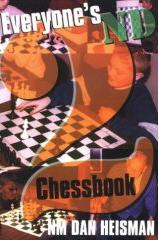 Sidebar - To be honest, I also have to give some credit here to Dan Heisman. He is the host of the ICC’s radio show “Ask the Renaissance Man”, writes the “Novice Nook” column at ChessCafe.com, and is the author of the remarkable book “Everyone’s 2nd Chess Book”. So far I have only perused his book (I’ll write a full review of it once I’ve read it all). By following the list of guidelines in his book I’ve seen a tremendous improvement in my game. Thank you, Dan Heisman. Take this advice: If you are a chess novice or a low rated experienced player you must really buy this book. You will not regret it.
As a former teacher, I know the importance of a curriculum. My very first step then is to design my personal chess curriculum. To begin, I need to complete some tasks. For now I will simply list these tasks. Later I will follow up on each of them with more detailed posts:
- Define my goals. What is it that I personally want to accomplish with my chess improvement plan? How will I measure my progress?
- List of the chess resources I already have and those I may wish to add:
- Books I already own
- Books I may wish to purchase
- Software I already own
- Software I might wish to purchase
- Helpful Internet resources I can use
- My chess history – what score sheets and PGN records of my games do I have?
- Plan an agenda using selected resources from my list.
- Implement a schedule for study and game playing.
- Follow through conscientiously with my plan and see what
happens.
Friday, August 25, 2006
Book Review: Chess for Children
Here is a good book with some great ideas for teaching chess to young and old alike. Although written for children ages 9 to 12, I think its best use is for a teacher or parent wanting to teach a a young child (or anybody for that matter) the game of chess in an easy-to-understand kind of way.
The book succeeds splendidly at this by introducing small “chunks” of chess knowledge. Using a variety of chess game variations, puzzles, and activities, the student gradually learns all the rules of the game in a fun and interesting way.
Take for example “The Pawn Game”. What’s so great about this is that you can begin to play a simplified form of chess having only learned how a single piece moves and captures! Even better, you are actually learning solid chess fundamentals as to how to use pawns in the full game of chess.
In addition to “the Pawn Game” the authors introduce many other “mini” chess activities like the “Attack of the Mad Queen” game and the “Knight Driving Test” challenge.
Because of this approach, learning the rules of chess becomes something fun and not a confusing and overwhelming experience for the new player.
Highly recommended!
Chess for Children (Paperback) 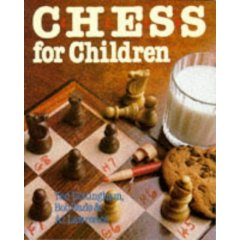
- by Ted Nottingham, Bob Wade, Al Lawrence
- Reading level: Ages 9-12
- Paperback: 128 pages
- Publisher: Sterling; New Ed edition (June 30, 1996)
- Language: English
- ISBN: 0806904534
- Product Dimensions: 10.0 x 8.0 x 0.4 inches
- Shipping Weight: 10.88 ounces
- Average customer review: 4 out of 5 based on 8 reviews
My copy was purchased from http://www.amazon.com/.com re-seller the_book_depository_ltd. To buy from the Amazon listing click this link Used & new then select the "New" tab and you'll see them. Good price - total with shipping from the U.K. was only $13.85. Got it delivered in about 10 days. New and used copies are also available from other re-sellers too.